

A baseball field’s surface may appear to be a minor detail, but it has cultural and athletic significance that significantly influences the game itself. Kentucky bluegrass is the most widely used grass in Major League Baseball because of its dense resilience and subtle blue-green color. Many stadiums depend on it to maintain consistent play because of its exceptional durability, which includes its strength under high foot traffic and its capacity to bounce back quickly from wear. It gives athletes a very effective surface to run on, and it gives spectators an emerald canvas that makes the whole show better.
However, the type of grass that is selected is greatly influenced by the climate. Kentucky bluegrass grows naturally in cooler or transitional climates, which explains why it is so prevalent in ballparks in the north and midwest. Bermudagrass, on the other hand, has proven especially useful in southern venues where the hot summers necessitate a turf that can tolerate intense heat while still recovering quickly. This adaptation is best seen in Houston’s Minute Maid Park, which has switched from artificial turf to warm-season grass types like paspalum, which fare much better in the harsh climate of the city.
When artificial turf was first introduced in 1966 at the Houston Astrodome, it held out the promise of an innovative revolution. When it was first introduced as ChemGrass and then redesigned as AstroTurf, it seemed remarkably adaptable for multipurpose spaces. Players quickly realized its shortcomings, though, as injuries significantly increased, surfaces became dangerously hot, and balls bounced abnormally high. Eventually, what was advertised as an incredibly obvious maintenance solution turned out to be a player safety compromise. Only five Major League Baseball stadiums still have artificial turf today, and even these have been greatly enhanced to more closely resemble real grass.
Baseball Field Grass Profile
| Category | Details |
|---|---|
| Most Common Grass | Kentucky Bluegrass (used in 16 MLB stadiums, plus infields of others) |
| Alternative Options | Bermudagrass, Perennial Ryegrass, Fescue blends |
| Artificial Turf | Present in 5 MLB stadiums (Arizona, Texas, Miami, Tampa Bay, Toronto) |
| Climate Influence | Cool zones favor Bluegrass; warm zones prefer Bermuda or Zoysia |
| Notable Example | Yankee Stadium – Kentucky Bluegrass with heating and lighting systems |
| Historic Note | Houston Astrodome first used AstroTurf in 1966 |
| Performance Factors | Durability, wear tolerance, quick recovery, weather adaptability |
| Groundskeeping Needs | Mowing, watering, verticutting, pest control, turf painting, tarping |
| Cultural Impact | Iconic patterns created by bending blades of Kentucky Bluegrass |
| Reference | Heartland Turf & Landscape |
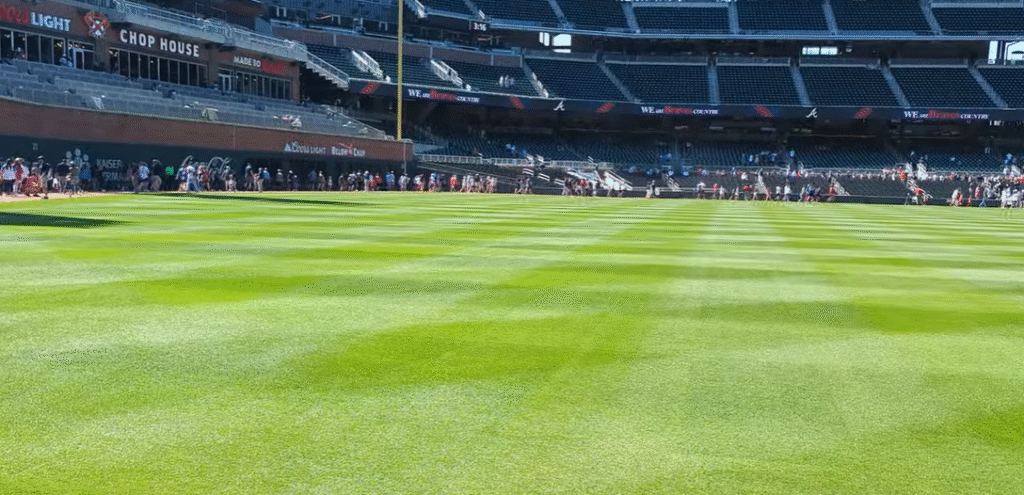
By turning grass into a stage that is as memorable as the athletes who compete on it, groundskeepers have evolved into independent artists. To guarantee that early-season games look perfect, Yankee Stadium’s crew uses heated soil lines, grow-light rigs, and even trucked-in sod. Dave Mellor, the renowned head groundskeeper of Fenway Park, has received recognition for his checkerboard and diamond patterns that remarkably resemble living art. These patterns, which are produced by bending Kentucky bluegrass blades rather than cutting them, demonstrate how the surface serves more purposes than just being useful; it also tells an aesthetically pleasing story.
Players adjust their play to the field underneath them, highlighting the significance of grass type. A ground ball gliding over Kentucky bluegrass responds differently than one rolling across Bermudagrass. The constant traction Yankee Stadium’s turf offered contributed to the legend surrounding Derek Jeter’s acrobatic shortstop throws. Ichiro Suzuki, meanwhile, was able to transform infield hits into iconic moments thanks to Seattle’s ryegrass blend, which enhanced his renownedly explosive sprints.
Grass and identity have a deeply cultural relationship. Because many baseball fans associate the smell of freshly cut grass with summer, baseball’s natural fields serve as a reminder of tradition. Since baseball fans want to replicate the ambiance of their favorite stadiums in their backyards, Scotts Miracle-Gro even teamed up with MLB to sell stadium-seed blends to homeowners. It emphasizes how grass—which is surprisingly inexpensive in seed form but meticulously cultivated by experts at scale—becomes a part of the collective experience of the community.
Additionally, technology has entered the picture, fusing art and science. While Oracle Park in San Francisco implemented Tifway 419 Bermuda in its infield to manage fluctuating coastal temperatures, Citi Field uses clear tarps to create greenhouse effects in the early spring. In order to maintain incredibly clear and productive fields throughout the season, turf management has become especially inventive, incorporating ideas from sports technology, agriculture, and climate science. This delicate balance between nature and engineering is demonstrated by this.
Discussions concerning convenience and authenticity are reflected in the argument between artificial turf and natural grass. Many former players and other baseball purists contend that the game loses some of its essence when natural grass isn’t used, pointing out that the sport’s sensory connection to nature, unpredictable hops, and grass stains are all essential. However, proponents of artificial turf emphasize its durability and affordability for multipurpose spaces. However, the cultural and athletic momentum still favors real grass in spite of these arguments.
Grounds crews must adjust to the new demands of climate change by using sustainable practices and hybrid blends. The sport illustrates how adaptation is crucial for survival, whether it is through better irrigation systems, drought-resistant grasses, or tarping techniques. This evolution is strikingly similar to baseball itself in many respects—it strikes a balance between tradition and change, history and innovation.
